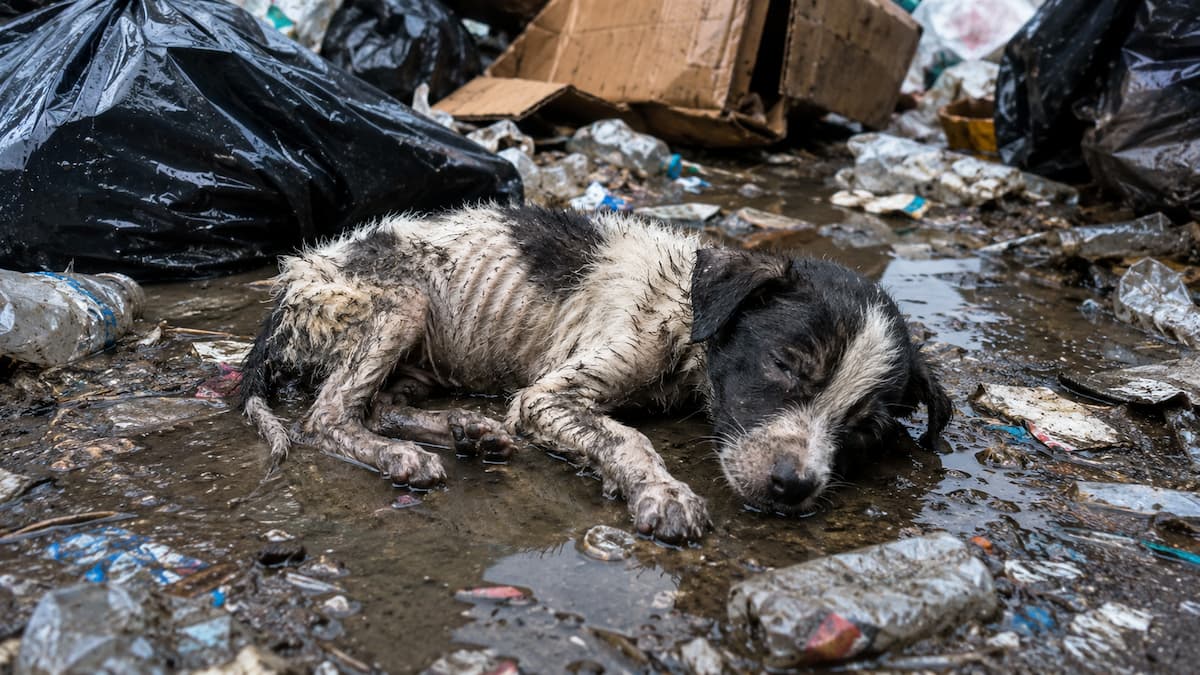
Among the black trash bags, broken plastic bottles, and rain-soaked cardboard boxes, a tiny black-and-white puppy lay completely still.
His body was so thin that every rib could be seen beneath his skin.
Mud covered his fur.
His eyes had sunk deep into his face.
Flies circled around him, but he no longer had the strength to chase them away.
No one knew how many days he had been lying there.
No one knew when he had eaten his last real meal.
The puppy could only stare weakly at the gray sky above the garbage dump.
Every breath was small.
Every blink seemed difficult.
Still…
Somewhere inside his fragile body, a tiny part of him had not given up.
He tried to lift his head.
For one brief second, his neck moved.
Then his face fell back onto the wet cardboard.
His stomach had been empty for too long.
His legs no longer obeyed him.
He could not stand.
He could not crawl away.
He could not even cry loudly enough for anyone to hear.
Cars passed on the nearby road.
People walked past the entrance to the dump.
But from a distance, the puppy looked like nothing more than another piece of discarded trash.
Then one afternoon, a man walking home noticed something unusual.
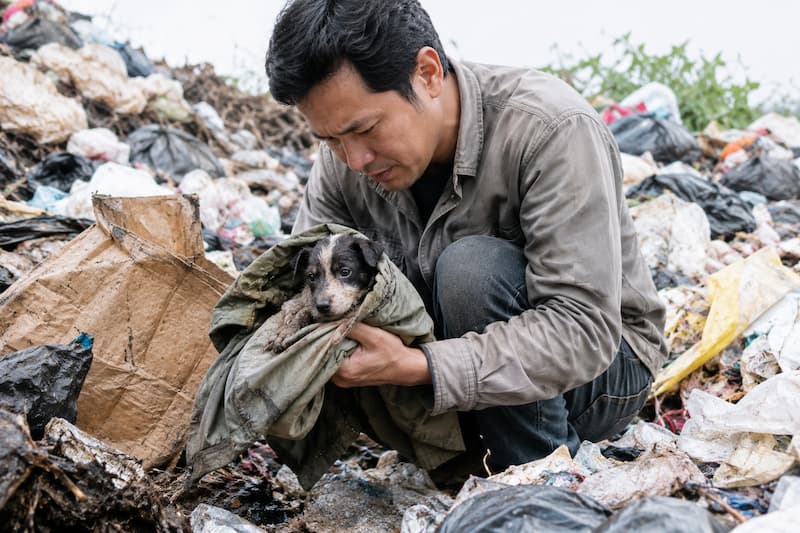
Between two black bags, he saw a pair of eyes blink.
At first, he thought the movement came from a rat.
He stepped closer.
Then he saw the small black ear.
The thin white chest.
The body that barely moved.
The man dropped his bag and ran toward the puppy.
He knelt in the dirt.
For a moment, he was afraid to touch him.
The puppy looked so weak that even a gentle hand might hurt.
The man removed his coat and carefully wrapped it around the tiny body.
When he lifted the puppy, there was almost no weight in his arms.
The little dog opened his eyes.
He looked at the man for only a second.
Then he rested his head against the warm coat.
That weak glance changed everything.
The man had planned only to walk home.
Instead, he carried a dying puppy with him.
His house was small and simple.
There was no special animal room.
No expensive equipment.
But the man found several clean towels and placed them inside a wooden box.
He covered the towels with a soft blanket.
Then he laid the puppy down.
For the first time in many days, the little dog was no longer lying on garbage.
The man warmed some water.
He gently cleaned the mud from the puppy’s fur.
Beneath the dirt, the black-and-white coat was still beautiful.
The puppy was too weak to react.
He simply watched with tired eyes as the man wiped his face, his paws, and his thin body.
Then the man wrapped him in another warm blanket.
He placed a small bottle filled with warm water beside him.
The puppy slowly leaned toward the heat.
That night, the man prepared a thin porridge.
He knew the puppy could not eat a full meal.
So he used a tiny spoon.
One small spoonful.
Then another.
The puppy struggled to swallow.
Sometimes the food remained in his mouth.
The man waited patiently.
He never forced him.
He never became frustrated.
Every few minutes, he offered another drop of water.
Another tiny taste of food.
Each spoonful seemed almost too small to matter.
But those tiny spoonfuls were keeping the puppy alive.
The man sat beside the box all night.
He changed the warm bottle when it became cold.
He checked the blanket.
He watched the puppy’s chest rise and fall.
Sometimes the breaths became so faint that the man leaned closer in fear.
He placed two fingers gently against the puppy’s body.
There was still a heartbeat.
Weak.
Slow.
But still there.
The man barely slept.
He was afraid that if he closed his eyes for too long, the puppy might stop breathing.
So he remained beside him until morning.
The next day was difficult.
The puppy refused food.
His body shook.
His eyes stayed closed for hours.
The man considered taking him to a clinic, but the nearest one was far away.
He borrowed a bicycle and carried the puppy in a box lined with blankets.
At the veterinary clinic, the doctor examined him.
The puppy was severely malnourished and dehydrated.
His body temperature was dangerously low.
There was no promise he would survive.
The doctor gave him fluids and medicine.
Then he told the man that the next few days would be critical.
The man brought him home.
He did not ask whether caring for the puppy would be difficult.
He did not calculate the cost.
He simply continued.
Every two hours, he offered water.
Every meal was given in tiny portions.
Every night, he checked the puppy’s breathing.
He began calling him Patch because of the black patches around his white face.
For several days, Patch did not respond to the name.
He was too tired.
But the man continued saying it softly.
“You are safe, Patch.”
“You are not alone.”
“Stay with me.”
On the seventh day, something changed.
The man entered the room carrying a bowl of food.
Patch’s ears moved.
Only slightly.
But they moved.
The man stopped.
He smiled.
Patch opened his eyes and looked toward him.
There was still weakness in that gaze.
But there was also recognition.
For the first time, Patch seemed to understand that the footsteps entering the room belonged to someone who would not hurt him.
Whenever the man appeared, the puppy’s eyes grew a little brighter.
That small change gave the man hope.
He began sitting closer while Patch ate.
Sometimes he placed a hand beside the puppy without touching him.
After several days, Patch moved his head and rested his chin against the man’s fingers.
It was the first time he had chosen to make contact.
The man felt tears fill his eyes.
Patch had been thrown away.
Ignored.
Left to die among garbage.
Yet his heart was still willing to trust.
On the fifteenth day, Patch tried to sit up.
His front legs trembled beneath him.
He pushed against the blanket.
His body rose for one second.
Then two.
The man held his breath.
Patch remained upright for only a few moments before falling gently onto his side.
But the man clapped softly.
“That was wonderful,” he said.
Patch looked at him.
His tail moved against the blanket.
It was almost invisible.
But it was a wag.
Only a few seconds of sitting.
Only one tiny movement of the tail.
Still, it felt like a victory.
The next days were filled with small victories.
Patch began eating from a shallow bowl.
He could hold his head up longer.
He started watching the man move around the room.
When sunlight entered through the window, Patch turned his face toward it.
His body was still painfully thin.
But life had begun returning to him.
By the thirtieth day, Patch was ready to try walking.
The man carried him into the small yard.
He placed him on a patch of grass.
Patch stared down.
Perhaps he had forgotten what grass felt like.
Perhaps he had never known.
He moved one front paw.
Then another.
His back legs shook.
He took one step and fell.
The man reached toward him but stopped before lifting him.
Patch tried again.
One step.
Two steps.
Then he fell once more.
The man sat nearby and encouraged him.
Patch rested for a moment.
Then he pushed himself up.
Again.
And again.
Falling did not frighten him.
He had already survived something far worse.
Every morning, they practiced.
Patch walked beside the man’s hand.
Sometimes the man supported his chest with a towel.
Sometimes Patch moved alone.
The distance was never far.
At first, he reached only the edge of the porch.
Then the small tree.
Then the garden gate.
Each step carried him farther from the garbage dump.
Each step taught his body that it belonged among the living.
The man also began giving Patch small toys.
The puppy did not understand them at first.
He stared at a rubber ball without moving.
Then one afternoon, the ball rolled gently across the floor.
Patch followed it with his eyes.
The man rolled it back.
Patch stretched one paw toward it.
The ball moved again.
His ears lifted.
For the first time, curiosity replaced fear.
By the forty-fifth day, Patch looked like a different dog.
His black-and-white fur had become clean and soft.
His ribs were no longer as visible.
His face had filled out.
His eyes shone.
He began chasing the ball through the yard.
His movements were still awkward.
Sometimes he stumbled.
But now, whenever he fell, he jumped up quickly.
His tail wagged almost constantly.
Patch was no longer only surviving.
He was beginning to enjoy being alive.
The man returned to work during the day.
At first, he worried that Patch would be afraid when left alone.
So he came home early whenever possible.
One evening, he opened the garden gate.
From inside the yard, Patch lifted his head.
His ears stood tall.
The moment he heard the familiar sound, his entire body changed.
His eyes brightened.
His tail began moving wildly.
Then he ran.
Not walked.
Not crawled.
Ran.
The man froze.
Patch crossed the yard as fast as his young legs could carry him.
He stumbled once.
Recovered.
Then continued.
When he reached the man, he jumped against his knees.
The man knelt and caught him.
Patch licked his hands and face.
He made small excited sounds.
The puppy who had once been unable to lift his head was now running to welcome someone home.
The man held him tightly.
For weeks, he had fought to keep Patch alive.
Now Patch was showing him why the fight had mattered.
The days continued.
Patch grew stronger.
He learned the sound of the man’s bicycle.
He learned where the food was kept.
He learned that night did not mean he would be abandoned.
He slept beside the man’s bed.
Sometimes he woke from bad dreams and searched the room.
The man would reach down and touch his head.
Patch would relax again.
On the sixtieth day, the man took Patch to a field near the house.
The grass was green.
The morning sky was clear.
Patch stood beside him with bright eyes.
The man removed the leash.
For one moment, the puppy remained still.
Then he ran across the field.
His black-and-white body moved through the sunlight.
His ears bounced.
His tail flew behind him.
He ran in wide circles.
He chased birds.
He rolled in the grass.
Then he heard the man call his name.
Patch turned.
Across the field stood the person who had found him among the trash.
The person who had wrapped him in a coat.
Fed him with a spoon.
Stayed awake through the night.
Believed in him when even the doctor could not promise he would survive.
Patch began running toward him.
Faster and faster.
His face seemed filled with pure happiness.
The man opened his arms.
Patch jumped directly into them.
For a moment, the man could not speak.
He only held the puppy against his chest.
Sixty days earlier, that same body had been cold and almost lifeless.
Now it was warm.
Strong.
Full of joy.
Patch licked the man’s hands again and again.
Then he curled into his arms and rested his head there.
The man was no longer only his rescuer.
He was no longer a stranger.
He was family.
That evening, they sat together on the front steps.
The sun slowly disappeared.
Patch slept in the man’s lap.
His breathing was calm.
His stomach was full.
His fur smelled clean.
There were no flies.
No broken bottles.
No wet cardboard beneath him.
Only warm hands and a safe home.
In the weeks that followed, people in the neighborhood often saw Patch running through the garden.
Some could not believe he was the same puppy from the garbage dump.
He played with his red ball.
He followed the man everywhere.
And every evening, when the gate opened, he ran to welcome him home.
Patch had not needed a miracle.
He needed food.
Warmth.
Patience.
Medicine.
And one person who refused to give up.
Many animals are not lost because they are too weak to survive.
They are lost because no one stops long enough to see them.
The man almost walked past that garbage dump.
Patch almost became invisible among the discarded things.
But one small blink caught his attention.
One weak pair of eyes asked for help.
And one act of kindness changed two lives forever.
Sixty days earlier, Patch had looked toward the sky because he could no longer stand.
Now he ran beneath it.
Sixty days earlier, he had been waiting to die alone.
Now he waited at the gate for the person he loved most.
Because sometimes love does not arrive like a great miracle.
Sometimes it arrives as a warm coat.
A spoonful of food.
A hand that stays through the night.
And a promise made without words:
You were abandoned once.
But I will never leave you again. ❤️
