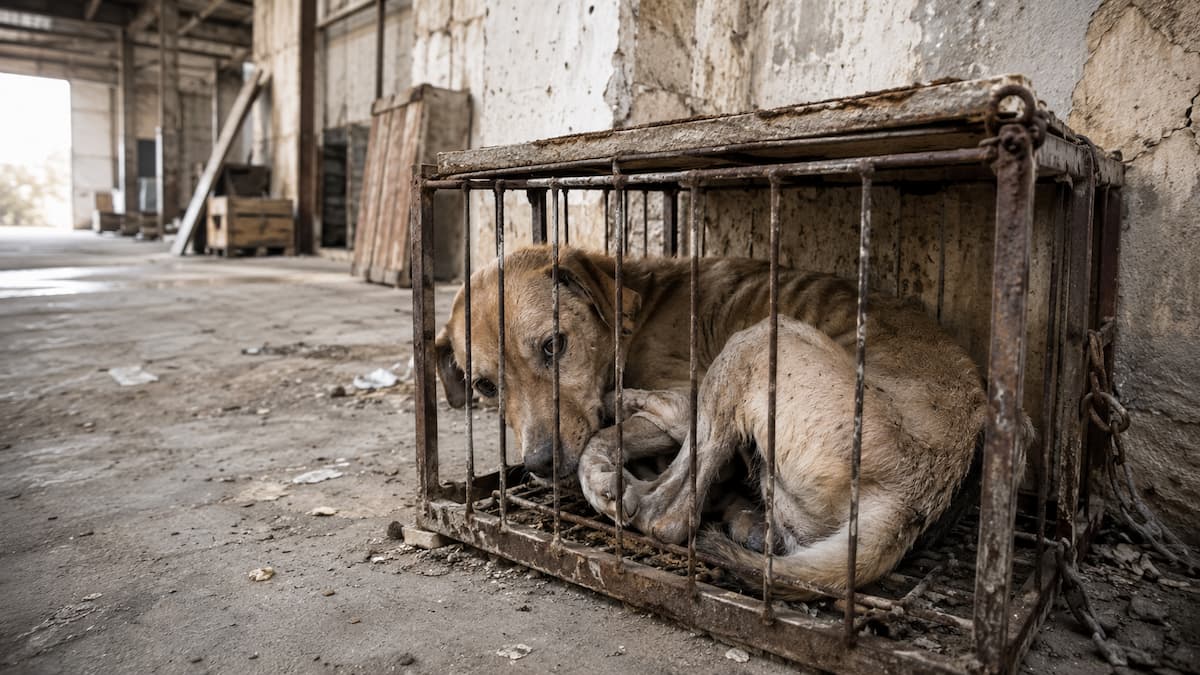
In the darkest corner of an abandoned storage room, beneath layers of dust and broken wood, stood a rusted iron cage.
It was so small that the dog inside could not stand.
He could not turn around without pressing his body against the bars.
He could not stretch his back.
He could not extend his legs.
The only position available to him was to remain curled into a tight ball.
Day after day.
Night after night.
Year after year.
The dog had golden-brown fur, though most of it was hidden beneath dirt and thick knots.
His body was painfully thin.
His four legs were folded against his chest at unnatural angles.
The joints had become swollen.
The bones had slowly changed shape.
He had not been born that way.
The cage had done it to him.
For so long, his legs had been forced to remain bent that his body had forgotten what it meant to stand straight.
A dirty bowl sat near his face.
Sometimes it held water.
A few pieces of dry food lay scattered across the metal floor.
There was no blanket.
No sunlight.
No room to move.
Only cold iron beneath him and narrow bars around him.
A thin line of light entered through a crack in the wall each morning.
The dog watched it move across the floor.
That small ray of sunlight was the only sign that another day had begun.
Sometimes he heard birds outside.
Sometimes he heard footsteps in the distance.
Whenever someone came near the storage room, his ears lifted.
But the footsteps always disappeared.
Eventually, he stopped expecting the door to open.
He stopped trying to bark.
He stopped believing that the world beyond the cage still had a place for him.
Then one afternoon, a local rescue worker received a report about an animal being kept inside an old building.
The message contained very little information.
Only an address and a few words:
“There is a dog inside. Please come quickly.”
The rescuer drove there alone.
The building looked empty from the outside.
The windows were covered.
The door was difficult to open.
When he finally stepped inside, the air smelled of damp wood and rust.
He called softly.
No answer came.
Then he heard a faint scraping sound from the back of the room.
He followed it.
When he saw the cage, he stopped.
At first, he could not understand what he was looking at.
The dog’s body was folded so tightly that his legs seemed almost hidden beneath him.
His head rested against the bars.
His eyes were open, but they held no expectation.
The rescuer slowly approached.
The dog did not bark.
He did not growl.
He did not try to move away.
There was nowhere to move.
The man knelt in front of the cage.
The dog looked at him for a moment.
Then he lowered his eyes.
The rescuer felt anger rise inside him.
But he pushed it away.
The dog did not need anger.
He needed gentleness.
“No one should live like this,” the man whispered.
He examined the lock.
It was covered with rust.
After several attempts, it finally broke.
The cage door opened.
For the first time in years, there were no bars blocking the space in front of the dog.
The rescuer moved back.
He expected the dog to crawl forward.
But the dog remained completely still.
The door was open.
Freedom was only a few inches away.
Yet the dog did not understand what freedom meant.
He stared at the empty space outside the cage.
Then he looked down at his twisted legs.
Perhaps he wanted to move.
Perhaps he was afraid his body could no longer carry him.
The rescuer did not reach inside.
He did not pull the dog out.
Instead, he spread a thick blanket across the floor in front of the cage.
Then he sat down.
Minutes passed.
Dust moved through the narrow beam of sunlight.
The dog watched him carefully.
The man placed a small bowl of water on the blanket.
He waited.
At last, the dog moved his head forward.
Then one front paw slid toward the open door.
The leg trembled violently.
He pulled it back.
The rescuer remained still.
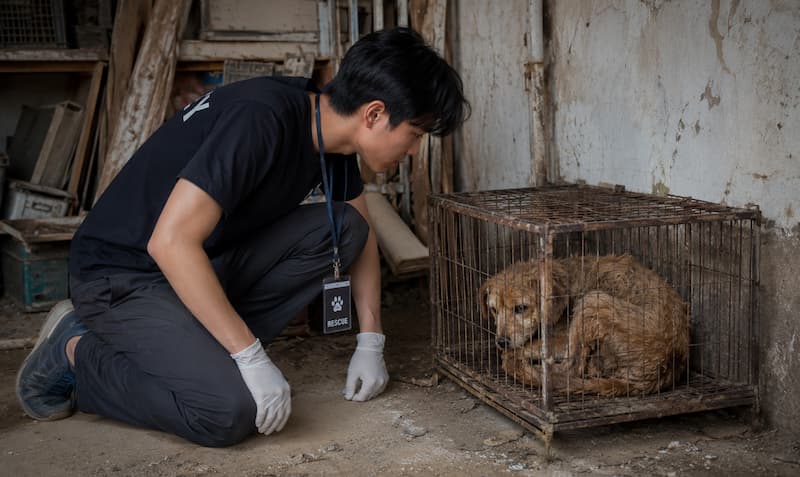
The dog tried again.
This time, part of his body moved beyond the bars.
He did not walk out.
He crawled.
Slowly.
Painfully.
Using his elbows and chest, he dragged himself onto the blanket.
The moment his body left the cage, he froze.
The space around him was too large.
There were no bars touching his back.
Nothing pressed against his sides.
He began to shake.
The rescuer gently moved closer and wrapped the blanket around him.
The dog did not resist.
He simply closed his eyes.
That was the first moment of his new life.
The man named him Hope.
Not because the dog seemed hopeful.
But because the rescuer wanted him to become hopeful again.
At home, Hope was placed on a thick mattress near a warm window.
For the first time, his body rested on something soft.
He remained curled into the same position he had used inside the cage.
Even without the bars, he did not stretch.
His muscles did not know how.
The rescuer warmed several towels and placed them over Hope’s legs.
Then he began gently massaging each joint.
Hope flinched.
Years of stiffness had made even small movements painful.
The man stopped whenever the dog became uncomfortable.
Then he tried again later.
There was no miracle.
No sudden recovery.
Only patience.
Every morning began with warm towels.
Every afternoon included gentle movement.
Every evening ended with the rescuer sitting beside Hope’s bed.
Sometimes he spoke.
Sometimes they remained silent.
Hope did not need promises.
He needed someone who returned the next day.
A veterinarian examined him.
The doctor studied the bent legs, stiff joints, and weakened muscles.
The damage was severe.
Hope might never walk normally.
His legs could improve, but they might always remain slightly curved.
The recovery would take months.
Perhaps longer.
The rescuer listened carefully.
Then he looked at Hope.
The dog was watching him.
One small fear appeared in his eyes, as though he expected to be unwanted again.
The man placed a hand beside him.
“We will try,” he said.
That was enough.
Soft supports were made for Hope’s legs.
At first, the braces frightened him.
He tried to pull away when they were placed around his joints.
The rescuer moved slowly.
He allowed Hope to smell each piece.
He placed them beside the bed before asking him to wear them.
Every day, Hope tolerated them a little longer.
The supports did not force his legs straight.
They simply reminded his body of a position it had forgotten.
A little at a time.
Slowly.
Always moving forward.
Outside the house, the rescuer built a special path.
He covered the ground with soft grass mats and thick foam.
Low wooden rails stood on both sides so Hope could lean against them.
The path was not long.
It stretched only from the porch to a small tree in the garden.
But to Hope, it looked endless.
The first time he was carried outside, sunlight touched his fur.
He closed his eyes.
A breeze moved across his face.
The sounds were unfamiliar.
Birds.
Leaves.
Distant voices.
For years, the world had reached him only through a crack in a wall.
Now it surrounded him.
The rescuer placed Hope at the beginning of the soft path.
His legs folded beneath him.
At the other end, the man sat on the ground.
He called Hope’s name.
The dog lifted his head.
Then he tried to push himself up.
His front legs shook.
One collapsed immediately.
Hope fell onto the mat.
The rescuer did not look disappointed.
He smiled.
He waited.
Hope tried again.
This time, he lifted his chest for one second.
Then two.
One paw moved forward.
His body followed.
It was not a full step.
But it was more movement than he had made in years.
The man’s eyes filled with tears.
To most people, it would have looked like almost nothing.
To Hope, it was the beginning of everything.
Each morning, they returned to the path.
Some days were good.
Hope managed several small steps.
Other days, the pain was stronger.
He could barely lift his body.
The rescuer never forced him.
On difficult mornings, they simply sat together beneath the tree.
Hope watched the garden.
Then they tried again the next day.
He fell many times.
His legs crossed beneath him.
His paws slipped.
His body became tired after only a few seconds.
Still, he continued.
Fall.
Rest.
Stand.
Try again.
The cage had taught his body to remain still.
Love was teaching it to move.
After several weeks, Hope could stand with support.
The rescuer placed one hand beneath his chest and another near his back legs.
Hope slowly extended his joints.
The movement was small.
But each day, his legs became a little less tightly folded.
The man celebrated every improvement.
One more second standing.
One more step forward.
One less fall.
Hope began to understand the excitement in his voice.
Whenever the rescuer praised him, Hope’s tail moved against the mat.
At first, it was only a tiny movement.
Then it became a real wag.
One morning, the rescuer brought Hope to the soft path as usual.
He placed him near the beginning.
Before the man could support him, Hope pushed against the ground.
His front legs trembled.
His back legs remained bent.
But his body rose.
The rescuer held out his hands without touching him.
Hope stood alone.
Five seconds.
Ten.
Twenty.
His entire body shook with effort.
But he did not fall.
The rescuer covered his mouth.
Tears ran down his face.
Hope looked at him.
His tail began moving.
For most dogs, standing was ordinary.
For Hope, it was a miracle created by hundreds of painful attempts.
When he finally lowered himself onto the mat, the man crawled forward and embraced him.
Hope rested his head against the rescuer’s chest.
He could feel the man’s heart beating quickly.
For the first time, the dog understood that his courage could bring someone happiness.
Soon, Hope began walking short distances without help.
His steps were slow and uneven.
His legs were still curved.
But they could carry him.
The first time the garden gate opened, Hope stopped.
Beyond it was a wide field of grass.
There were no walls.
No cage.
No narrow path.
The sky seemed too large.
The rescuer walked beside him.
Hope placed one paw on the grass.
He froze.
The soft blades touched the sensitive pads beneath his feet.
He lowered his nose.
He smelled the earth.
Then he took another step.
And another.
He lifted his head toward the blue sky.
For years, he had watched sunlight through a crack.
Now he stood beneath it.
The world was so much larger than the cage.
At last, he was allowed to see it.
Weeks turned into months.
Hope’s body became stronger.
His golden-brown coat grew clean and bright.
He gained weight.
The old sores on his skin healed.
His legs never became perfectly straight.
But they relaxed enough for him to rest comfortably.
He could stretch while sleeping.
The first time he did, the rescuer stopped in the doorway.
Hope was lying on his side.
All four legs were extended across the bed.
He looked completely peaceful.
The cage no longer existed inside his body.
Soon, Hope began exploring the entire garden.
He smelled every flower.
He watched butterflies.
He followed the rescuer from the porch to the gate.
Sometimes he became tired and needed to rest.
But he no longer spent his days curled in one place.
Whenever the man called his name, Hope’s ears lifted.
He walked toward him as quickly as his curved legs allowed.
His tail wagged with every step.
He was not only learning how to walk.
He was learning how to be happy.
One evening, golden sunlight covered the garden.
The rescuer sat on the grass.
Hope slowly approached and lowered himself beside him.
Then he rested his head across the man’s leg.
His four paws stretched comfortably in front of him.
They were still slightly bent.
The damage had not disappeared.
But the pain no longer controlled his life.
The man ran his hand through Hope’s soft fur.
The dog looked toward him with calm eyes.
There were no bars between them.
No lock.
No dark room.
Only open grass.
Warm light.
And the person who had waited patiently for him to take his first step.
The cage had held Hope’s body for years.
It had changed his bones.
Weakened his muscles.
And taught him to fear open space.
But it had not destroyed the small part of him that still wanted to live.
Healing did not happen quickly.
It came through warm towels.
Gentle hands.
Soft braces.
Falling and standing again.
It came through one person returning every morning and refusing to give up.
Some wounds need more than medicine.
They need time.
They need patience.
They need someone who sees more than a damaged body.
Hope would never walk like other dogs.
But when he crossed the garden to greet the man who saved him, no one saw his bent legs.
They saw courage.
They saw trust.
They saw a life beginning again.
Because freedom is not only an open cage door.
Freedom is having someone wait outside that door.
Someone who will not drag you forward.
Someone who will sit beside you until you are ready.
And sometimes, the most beautiful journey does not begin with running.
Sometimes it begins with one trembling paw…
Taking the first step toward love. ❤️
