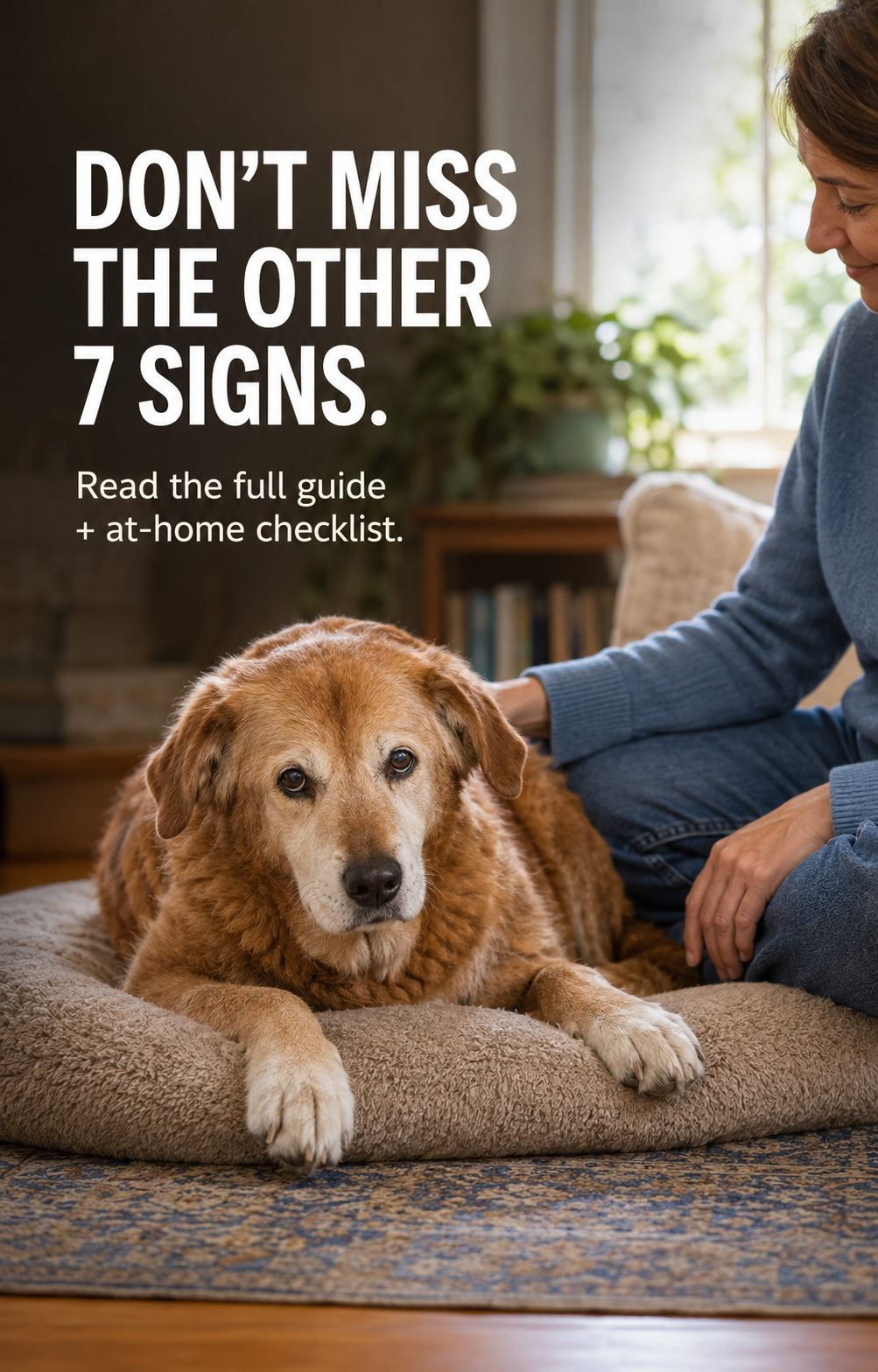
Every morning, the same small moment happens in homes everywhere.
A senior dog reaches the bottom of the stairs, looks up, and walks away. Later, he needs an extra few seconds to stand after his nap. He no longer follows the family from room to room as often as he once did.
His family may call it stubbornness. They may assume he is simply slowing down.
But dogs rarely tell us they hurt in obvious ways. They may not cry, limp, or refuse food. Instead, discomfort can appear as a pause, a different sleeping position, an unfinished walk, or a sudden change in personality.
Aging itself is not a diagnosis. Some changes commonly blamed on “old age” may be connected to pain, reduced mobility, dental disease, arthritis, or another condition that deserves veterinary attention.
The challenge is knowing what to notice.
Below are nine quiet signs that a senior dog may be uncomfortable, followed by a simple observation checklist you can use at home and share with your veterinarian.
Quick reminder: These signs do not prove that a dog is in pain. They are changes worth observing and discussing with a veterinary professional, especially when they are new, worsening, or interfering with normal activities.
1. Taking Longer to Stand Up
Watch what happens after your dog has been resting for a while.
Does he place his front feet carefully, shift his weight, hesitate, or make several attempts before standing? Does he appear stiff for the first few steps and then move more normally?
Difficulty rising can be associated with joint pain, arthritis, muscle weakness, or other mobility problems. According to the American Animal Hospital Association, difficulty standing, walking, or climbing stairs may indicate pain or joint issues.
An occasional slow morning does not reveal the cause by itself. What matters is whether the behavior is new, becoming more frequent, or affecting your dog’s normal activities.
Try recording a short video of your dog getting up after a nap. Dogs sometimes move differently at home than they do during a veterinary appointment, so a video may help your veterinarian evaluate the change.
2. Hesitating Before Using Stairs
A dog who once hurried upstairs may suddenly stop at the first step. Some dogs continue climbing but move slowly, place both back feet on the same step, or pull themselves upward with their front legs.
Going downstairs can be just as difficult. A senior dog may lower his head, pause repeatedly, or refuse to continue.
This hesitation is sometimes mistaken for fear or stubbornness. In reality, your dog may be anticipating discomfort, struggling with balance, or feeling uncertain about whether his legs will support him.
Do not pull or push a reluctant dog onto the stairs. Until your veterinarian evaluates the problem, consider blocking unsupervised access and using a properly fitted support harness when necessary.
3. Avoiding Slippery Floors
Tile, laminate, and hardwood floors can become challenging for an older dog.
You may notice your dog walking close to the wall, remaining on rugs, stopping at the edge of a smooth surface, or choosing a longer route through the house. Some dogs spread their feet wider in an attempt to maintain balance.
This behavior can indicate reduced strength, painful joints, poor traction, or fear of falling after a previous slip.
Adding nonslip runners or washable rugs along frequently traveled paths may make movement safer. Place them between your dog’s bed, food, water, and the door used for bathroom breaks.
Keep the rugs flat and secure so they do not create another tripping hazard.
4. Losing Interest in Walks or Play
A senior dog may still become excited when you pick up the leash but then move slowly, stop frequently, or ask to return home earlier than usual.
Other dogs stop bringing their favorite toy, lose interest in playing with another dog, or spend less time exploring the yard.
A decrease in activity does not automatically mean your dog is in pain. Changes in energy can have many possible causes. However, reluctance to walk, run, jump, or exercise is among the behavioral changes associated with discomfort and osteoarthritis.
Pay attention to patterns:
- Does your dog slow down near the end of a walk?
- Is he stiffer later that evening?
- Does he appear uncomfortable the next morning?
- Does the behavior change after a particularly active day?
- Is he avoiding one specific movement?
These details are more useful than simply telling your veterinarian that your dog is “slowing down.”
5. Panting While Resting
Dogs pant after exercise, during hot weather, and when they are excited or anxious. But repeated panting while resting in a comfortable environment may deserve closer attention.
Pain can contribute to panting, restlessness, or difficulty settling. A dog may repeatedly stand up, turn in circles, change positions, or move from one sleeping area to another.
Because panting can also be associated with heat, stress, medication effects, and potentially serious medical conditions, it should not be used to diagnose pain at home.
Contact your veterinarian if unexplained panting is new, persistent, or accompanied by other changes.
Seek emergency veterinary care for signs of breathing distress such as blue or gray gums, collapse, pronounced abdominal effort while breathing, or an extended head and neck.
6. Pulling Away From Touch
A normally affectionate dog may suddenly move away when you touch his back, hips, neck, legs, or mouth.
Other reactions may include:
- Turning the head quickly toward your hand
- Tensing the body
- Licking the lips
- Lowering the ears
- Growling or snapping
- Refusing to be picked up
- Avoiding grooming
- Leaving when someone sits nearby
Do not punish a dog for growling. A growl is a warning that the dog is frightened, uncomfortable, or asking for distance. Punishment may suppress the warning without addressing its cause.
Give your dog space and tell your veterinarian exactly where and when the reaction occurs. Do not repeatedly press or manipulate the sensitive area to “test” it yourself.
7. Becoming Quiet, Withdrawn, or Irritable
Pain does not affect every dog in the same way.
One dog may hide, sleep alone, or stop greeting family members at the door. Another may become restless, unusually needy, or reluctant to be left alone. A previously patient dog might growl when another pet approaches his bed.
According to Cornell University’s College of Veterinary Medicine, behavioral signs of pain can include social withdrawal, increased neediness, irritability, aggression, restlessness, or unusual reactions to touch.
Personality changes can also be connected to hearing loss, vision changes, cognitive decline, anxiety, or illness. That is why a veterinary examination is important, particularly when the change appears suddenly.
The goal is not to label your dog as “grumpy.” It is to ask what may have changed physically or emotionally.
8. Changing the Way He Eats
Pain may change how a senior dog approaches food.
Watch for signs such as:
- Dropping pieces of food
- Chewing only on one side
- Taking longer to finish a meal
- Walking toward the bowl but not eating
- Preferring soft food
- Refusing hard treats
- Pawing at the mouth
- Drooling more than usual
- Having noticeably bad breath
Dental disease can cause chronic pain and infection. Older dogs may have fractured teeth, inflamed gums, loose teeth, or disease below the gumline that is not obvious without a veterinary examination.
A dog who approaches the bowl but hesitates may also be uncomfortable lowering his neck. In some cases, changing the height or position of the bowl can affect comfort, but that does not replace an examination.
Call your veterinarian promptly if your dog stops eating, appears painful while chewing, or develops swelling or bleeding around the mouth.
9. Having Trouble Getting Comfortable at Night
Your dog may lie down, stand up, circle, and try again. He may wake repeatedly, pace through the house, whine, or begin sleeping during the day because he is restless at night.
Difficulty finding a comfortable position may be associated with pain. However, nighttime wandering can also occur with canine cognitive dysfunction and other medical conditions affecting senior dogs.
Keep notes about:
- What time the behavior begins
- How long it lasts
- Whether your dog pants or vocalizes
- Whether he appears confused
- Whether he needs to urinate or defecate
- Whether changing position seems difficult
- What helps him settle
A detailed record can help your veterinarian distinguish between discomfort, cognitive changes, urinary problems, anxiety, and other possible causes.
A Simple At-Home Observation Check
You do not need to diagnose your dog. Your job is to notice changes and communicate them clearly.
Once or twice a week, observe your senior dog during the same ordinary activities:
- Rising after a nap
- Walking across a room
- Turning in both directions
- Using a familiar step or doorway
- Eating and drinking
- Settling into bed
- Responding to gentle affection
- Taking a short, comfortable walk
Record a few short videos from the side and from behind. Keep a dated note describing good days, difficult days, appetite, sleep, bathroom habits, and willingness to participate in favorite activities.
The American Animal Hospital Association notes that home videos can help owners and veterinary professionals evaluate changes in movement and monitor a pet’s response to treatment.
When Should You Call Your Veterinarian?
Arrange a veterinary appointment when you notice a new or continuing change in your dog’s mobility, behavior, appetite, sleep, posture, or response to touch.
Call sooner if the problem is getting worse or interfering with normal activities.
Seek urgent or emergency veterinary care if your dog:
- Cannot stand or suddenly cannot use one or more legs
- Collapses or becomes extremely weak
- Has difficulty breathing
- Has blue, gray, or unusually pale gums
- Cries out repeatedly or appears severely distressed
- Develops a swollen or tight abdomen
- Experiences significant trauma
- Cannot urinate
- Has uncontrolled bleeding
- Becomes suddenly disoriented or unresponsive
When in doubt, call your veterinarian or an emergency animal hospital and describe what you are seeing.
Never Give Human Pain Medication Without Veterinary Direction
Do not give your dog ibuprofen, naproxen, acetaminophen, aspirin, or leftover medication unless a veterinarian specifically instructs you to do so for that dog.
Human medications can be dangerous or toxic to pets. Even medications sometimes used in veterinary medicine require an appropriate dose and consideration of the dog’s age, weight, kidney function, liver function, other illnesses, and current prescriptions.
Pain management should be designed by a veterinary professional.
Depending on the diagnosis, a treatment plan may involve prescription medication, weight management, rehabilitation, controlled exercise, environmental changes, or other therapies. There is no single safe solution for every senior dog.
Small Home Changes Can Make Daily Life Easier
While waiting for veterinary guidance, several low-risk environmental changes may improve safety and comfort:
- Place nonslip rugs on smooth floors.
- Keep food, water, and bedding easy to reach.
- Use a supportive bed in a quiet, draft-free location.
- Block unsafe stairs when supervision is unavailable.
- Keep nails appropriately trimmed for better traction.
- Help your dog enter vehicles instead of expecting him to jump.
- Choose shorter, gentler walks based on his current ability.
- Maintain a predictable daily routine.
Avoid forcing exercise or stretching painful limbs. Your veterinarian can recommend an activity level suited to your dog’s condition.
“Slowing Down” Is Still Worth Discussing
Your senior dog cannot tell you that standing hurts, that chewing feels different, or that the stairs have become frightening.
Instead, he communicates through small changes: a pause, a different posture, an unfinished meal, a shortened walk, or a quiet decision to sleep away from the family.
Not every change means your dog is in pain. But changes should not automatically be dismissed because he is older.
Careful observation and timely veterinary care may help identify treatable problems, improve mobility, and give your dog more comfortable days with the people he trusts most.
Sometimes the most loving thing we can do is stop calling it “just old age” and start paying attention.
Veterinary Sources and Further Reading
- Cornell University College of Veterinary Medicine: Recognizing Pain in Dogs
- American Animal Hospital Association: Assessing a Senior Pet’s Quality of Life
- AAHA Senior Care Guidelines: Pain Management
- American Veterinary Medical Association: Caring for Senior Pets
This article provides general educational information and is not a diagnosis or a substitute for veterinary care. Contact your veterinarian if you are concerned about a change in your dog’s health or behavior.
