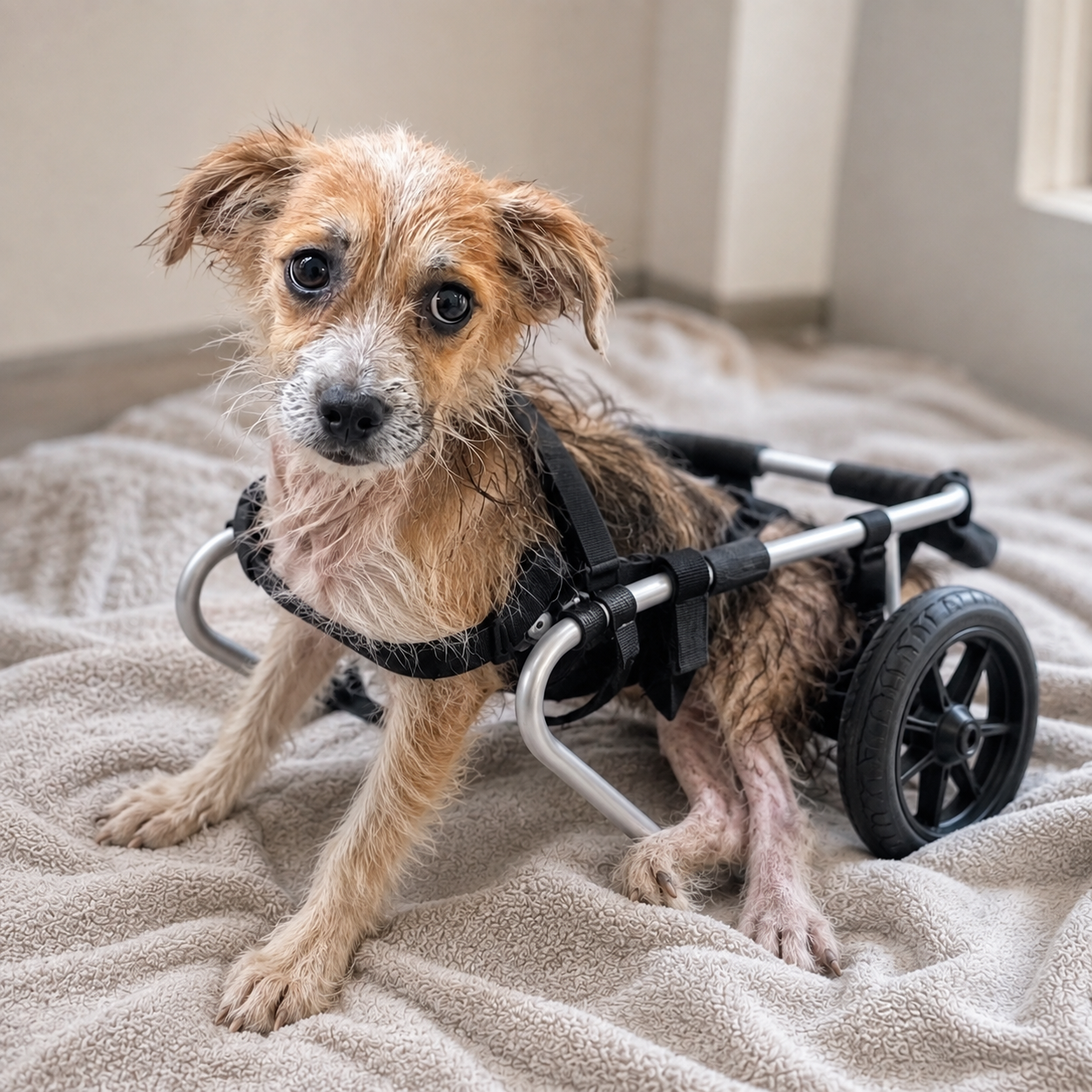
When the rescuers first found him, the little dog could barely move.
His two back legs were extremely weak.
Every time he tried to go forward, he pulled his body along with his front paws while his hind legs dragged behind him.
The movement looked exhausting.
But he never stopped trying.
If someone called his name, he lifted his head.
If food was placed a few feet away, he pulled himself toward it.
If his caregiver walked across the room, he tried to follow.
Slowly.
Painfully.
One front paw at a time.
They named him Milo.
During the first few days, the rescuers focused on keeping him comfortable.
He ate well.
He drank water.
He wagged his tail whenever someone sat beside him.
His personality was bright even when his body could not keep up.
That was what made everyone determined to help him move more freely.
One afternoon, his caregiver brought out a measuring tape.
Milo watched curiously as she measured the width of his hips, the length of his body, and the height of his back.
He had no idea why.
A few days later, a small mobility cart arrived.
It had two lightweight wheels and a padded frame designed to support Milo’s hindquarters.
The caregiver placed it on the floor.
Milo sniffed it.
Then backed away.
He clearly did not trust this strange new object.
The first time they fitted him into it, he simply stood there.
His front paws were on the ground.
His back half was supported by the cart.
But Milo did not move.
Not even an inch.
He looked from the wheels to his caregiver as if asking:
“What am I supposed to do with this?”
She knelt several feet in front of him.
“Come on, Milo.”
He stayed still.
So she held out a small treat.
His ears lifted.
Milo leaned forward.
One front paw moved.
The wheels rolled slightly behind him.
He froze.
Then he looked back.
Something had moved with him.
He tried again.
One step.
Then another.
The cart followed.
Milo stopped and stared at the ground.
His caregiver smiled.
“That’s it.”
A few minutes later, he tried three steps.
Then five.
Each time the wheels moved, he became a little less nervous.
The next day, Milo recognized the cart.
Instead of backing away, he sniffed it and wagged his tail.
That was the first sign that something had changed.
Once he was fitted into it, he started moving before anyone called him.
Slowly at first.
Across the room.
Then down the hallway.
Then toward the door.
A week later, they took him outside.
The grass seemed to confuse him.
The wheels moved differently over the uneven ground.
Milo stopped.
His caregiver walked ahead and called his name.
He looked at her.
Then he pushed forward.
One step.
Two.
Four.
The cart rolled behind him.
His pace became faster.
His ears lifted.
His tail began wagging.
Then his caregiver started jogging across the yard.
Milo watched her for half a second.
And suddenly he went after her.
The little dog who had once dragged himself across the floor was now racing over the grass.
The wheels bounced gently behind him.
His front paws moved as quickly as they could.
His mouth opened in what looked almost like a smile.
His caregiver laughed and kept running.
Milo followed.
Not because someone was training him.
Not because there was food waiting.
He followed because, for the first time, he could.
When they finally stopped, Milo stood in the cart panting happily.
His tail would not stop moving.
The wheelchair had not changed who he was.
It had simply given his body a way to keep up with the life he already wanted to live.
And from that day on, whenever Milo saw the little cart being brought toward him, he no longer looked afraid.
He looked excited.
Because he knew exactly what those two wheels meant.
They meant he could follow.
He could explore.
And most importantly—
he could run again.
