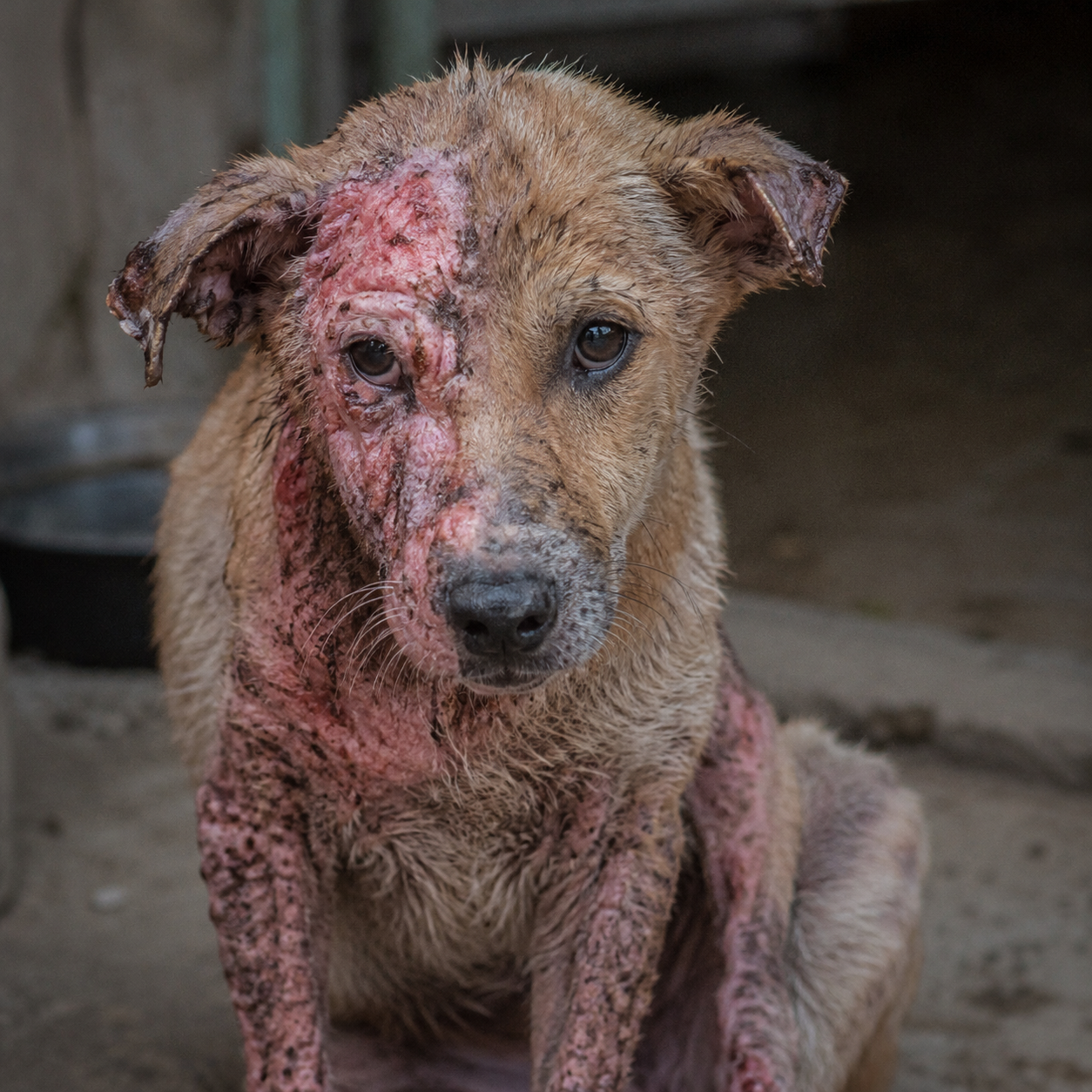
When rescuers first found him, the dog was hiding behind an abandoned shed.
He would not come out.
His body shook whenever anyone moved closer, and one side of his face was badly burned. The fur around his muzzle and cheek was gone, his skin was raw, and one ear had been damaged badly enough that it no longer stood normally.
Nobody knew exactly what had happened.
But it was clear that the injury was not recent.
He had been surviving with it for days.
Maybe longer.
They named him Cooper.
The first few nights were difficult.
Cooper refused to eat unless the room was completely quiet.
He flinched whenever someone reached toward his face.
Even when the rescuers changed his bandages, he kept his head turned away as if he expected pain every time a hand came near him.
So they stopped rushing him.
They sat beside him.
They spoke softly.
They left food within reach and waited.
On the fourth day, Cooper finally ate while someone was still in the room.
That small moment felt enormous.
Over the following weeks, his wounds began to close.
The swelling decreased.
Healthy skin slowly replaced the damaged tissue.
Some of his fur started growing back.
But his face would never look exactly as it had before.
One side remained scarred.
His ear stayed slightly folded.
And the shape around his cheek had changed.
The rescuers worried about how he would react once he became more active again.
But Cooper seemed more interested in something else.
People.
He had started trusting them.
He followed his caregiver around the room.
He waited near the door when she left.
And every morning, his tail moved a little faster when she returned.
Then came the day his bandages were finally removed for good.
His caregiver cleaned his face gently and let him walk around the room.
Cooper wandered toward a full-length mirror leaning against the wall.
He had passed it before.
But that day, he stopped.
There was another dog standing in front of him.
At first, Cooper froze.
His ears shifted.
He leaned forward.
The dog in the mirror did the same.
Cooper tilted his head.
So did the reflection.
Then he stepped closer.
His nose almost touched the glass.
For several seconds, he simply stared.
His caregiver stood behind him and said nothing.
She could see the scars clearly in the reflection.
The uneven fur.
The damaged ear.
The face that looked very different from the frightened dog they had rescued weeks earlier.
Cooper raised one paw and touched the mirror.
Then he looked behind it.
Nothing.
He returned to the glass.
For a moment, his caregiver expected him to become nervous.
Instead, Cooper sat down.
He looked at himself again.
Then his tail began to move.
Slowly.
Once.
Twice.
Then faster.
His caregiver covered her mouth.
Because Cooper did not understand scars.
He did not understand whether his face was beautiful or damaged.
He did not know that he looked different.
He only knew that the dog in the mirror moved when he moved.
And that the room around him was safe.
A few seconds later, Cooper turned away from the mirror and walked directly toward his caregiver.
He rested his head against her leg.
She knelt and gently touched the side of his face he once would not let anyone approach.
This time, he did not flinch.
He closed his eyes.
Weeks earlier, Cooper had hidden from every hand that came near him.
Now he leaned into one.
The mirror had shown him a different face.
But recovery had given him something much more important.
He was no longer the dog hiding behind the shed.
He was the dog who had survived it.
And when Cooper looked into that mirror for the first time after healing, the scars were not the biggest change.
The biggest change was that he was no longer afraid of the world looking back at him.
