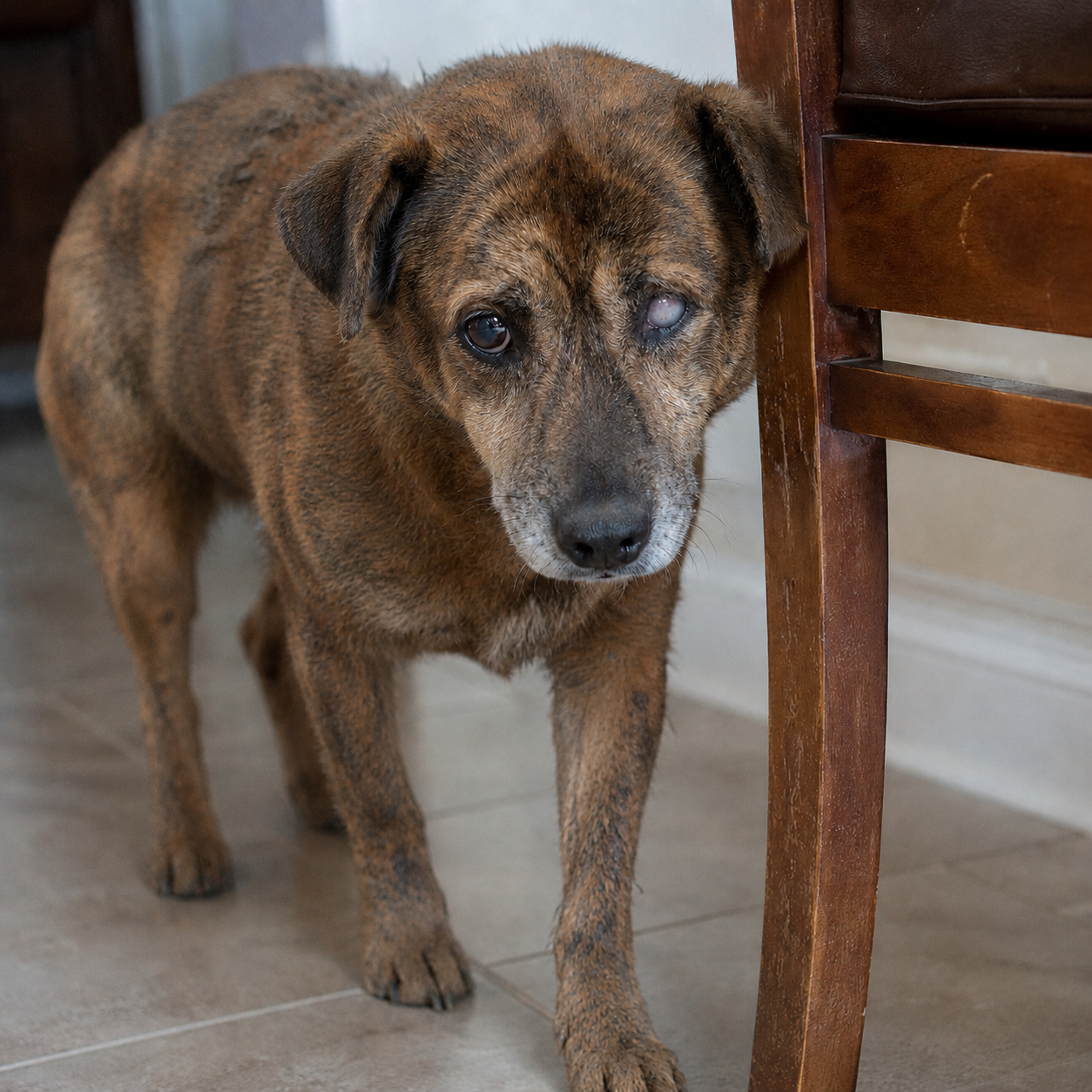
After the accident, Buddy had to learn how to live differently.
He had lost vision in one eye, and during the first few days of recovery, even simple movements became difficult.
He bumped into chair legs.
He misjudged doorways.
Sometimes he turned too quickly and hit the wall with his shoulder.
Before the accident, Buddy had loved playing with a ball more than almost anything else.
The moment someone picked it up, he would jump to his feet.
He would chase it across the room, carry it back, drop it at his caregiver’s feet, and wait impatiently for another throw.
But after losing sight on one side, the game changed.
When his caregiver rolled the ball toward him, Buddy often missed it.
Sometimes he heard it bounce but turned in the wrong direction.
Other times the ball passed right beside him and he never saw it.
After several failed attempts, Buddy would simply stop.
He sat quietly and stared at the floor.
It was as if he could not understand why something that had once been so easy had suddenly become so difficult.
His caregiver did not want him to give up.
So she tried something different.
Instead of using Buddy’s old ball, she brought out a special toy with a small bell inside.
The first time she shook it, Buddy immediately lifted his head.
His ears moved toward the sound.
She rolled the ball slowly across the floor.
The bell rattled.
Buddy turned.
He did not catch it.
But this time, he followed it.
That was enough to keep trying.
The next day, his caregiver stood only a few feet away and gently tossed the noisy ball.
Buddy listened carefully.
The ball bounced once.
He turned toward the sound.
Then he took a few steps.
He was still too slow.
But he was beginning to understand.
Over the next several days, they practiced again and again.
Short throws.
Slow rolls.
Gentle bounces.
Buddy learned to stop relying only on what he could see.
He started using his ears.
A bounce to the left.
A bell behind him.
A rattle moving across the floor.
Little by little, he became better at finding the direction of the sound.
Sometimes he still ran past the ball.
Sometimes he turned too late.
Sometimes he became frustrated and sat down.
But he no longer stopped trying.
Then one afternoon, his caregiver tossed the ball across the room.
It bounced once.
The bell rang.
Buddy turned immediately.
He ran toward the sound.
The ball bounced again.
Buddy changed direction.
Then, for the first time since the accident, he opened his mouth at exactly the right moment.
He caught it.
His caregiver froze.
Buddy stood there with the ball between his teeth.
Then his tail began wagging.
Faster.
And faster.
He ran back across the room and dropped the ball at her feet.
Then he nudged it forward.
He wanted another throw.
That small moment changed everything.
From then on, Buddy became more confident.
He practiced every day.
He learned how to turn his head so he could see more clearly from his good side.
He listened more carefully.
He learned how far away the ball was by the sound it made when it bounced.
Weeks later, Buddy was running across the yard again.
Not exactly the same way he had before.
But close.
He chased the noisy ball through the grass.
He turned toward every bounce.
He ran back to his caregiver with the same excitement he had shown before the accident.
Anyone watching from a distance might not have noticed anything unusual.
Buddy was simply a happy dog playing with his favorite toy.
The accident had taken vision from one eye.
But it had not taken his love of playing.
It had not taken his curiosity.
And it had not taken his joy.
Buddy did not recover by becoming exactly the dog he had been before.
He recovered by learning a new way to do something he still loved.
And the first time he caught that ball again, everyone around him understood something simple:
Sometimes healing does not mean getting everything back.
Sometimes it means discovering that happiness can still find another way forward.
