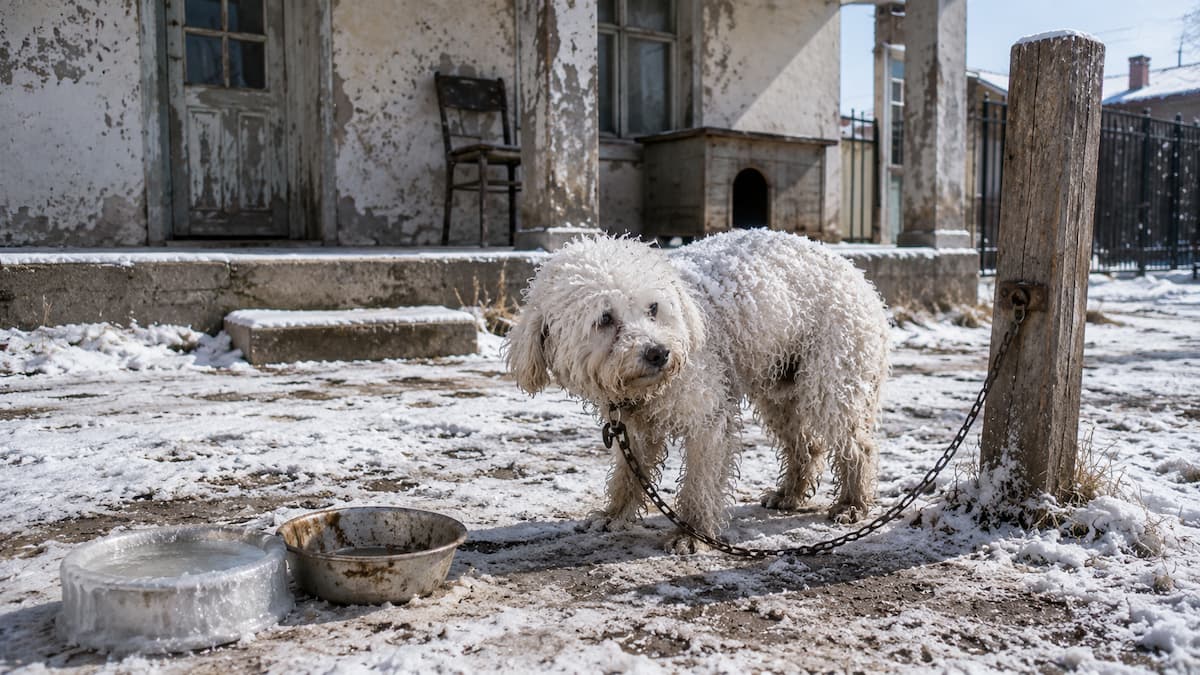
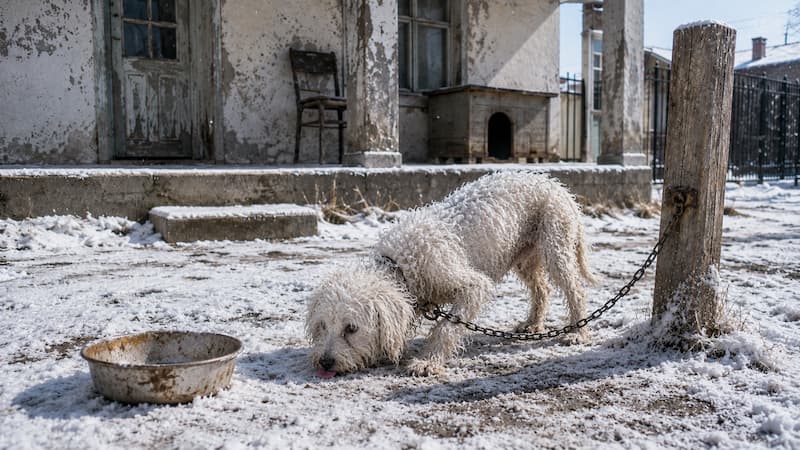
Winter arrived early that year, covering the quiet village in deep white snow and turning every roof, road, and garden into a frozen landscape. At night, families closed their curtains, gathered beside warm fires, and listened to the wind howl beyond their windows. But outside one old house, tied to a wooden post on the porch, a small fluffy white puppy had no fire, no blanket, and no one waiting to bring him inside. A short iron chain circled his thin neck. It was so tight and so short that he could barely move more than a few steps in any direction. Beside him sat two metal bowls. The water inside one had frozen into a solid block of ice. The other bowl was completely empty, polished clean by his desperate tongue. Snow covered his back and gathered between the curls of his once-soft white fur. Every few minutes, his whole body shook violently from the cold. He tried to curl into a ball, but the chain pulled against his neck whenever he moved too far from the post. He lifted his head each time he heard sounds from inside the house, hoping the door might open. Perhaps someone would remember him. Perhaps someone would bring food. Perhaps he would finally be allowed into the warmth. But the lights inside eventually went dark, and no one came. The puppy remained alone as night swallowed the village.
His name had once been Snowy, though no one had called him that for a long time. In the beginning, when he had first arrived at the house, he had been held, admired, and photographed. His fluffy coat had made everyone smile. But puppies grew. They needed food, patience, and care. Slowly, the hands that had once stroked him became impatient. The kind voices became angry ones. Then one morning, Snowy was taken outside and chained to the porch. At first, he believed it was temporary. He wagged his tail whenever someone walked past the window. He waited faithfully beside the door each evening. Days became weeks, and the chain remained. His world became a few wooden boards, one frozen bowl, and the small circle of ground he could reach. When hunger hurt too much, he stretched toward the empty food bowl, although he knew nothing would appear inside it. When thirst became unbearable, he licked snow from the porch and allowed it to melt slowly on his tongue. At night, he pressed himself against the wooden post to escape the wind. Sometimes he slept simply because sleep made the hunger disappear for a while. By the coldest morning of winter, Snowy no longer lifted his head when footsteps passed nearby. His eyes remained half closed, and his tail lay still beneath the snow.
That morning, an elderly woman named Mrs. An walked slowly along the village road. Her silver hair was hidden beneath a worn woolen scarf, and one hand gripped a wooden cane polished smooth by many years of use. She lived alone in a tiny house near the edge of the fields and survived by collecting bottles, old newspapers, and pieces of metal that others threw away. Her coat had been repaired so many times that the patches looked like part of its original design. She owned very little, but she never passed a hungry animal without sharing something from her small bag. As she approached the porch, she noticed a shape beneath the snow. At first, she thought it was an old blanket. Then the shape moved weakly. Mrs. An stopped. Through the white flakes, she saw two tired eyes looking back at her. She moved closer and discovered the short chain, the frozen water, and the empty bowl. For several seconds, she could not speak. Snowy tried to stand when she approached, but his legs failed beneath him. He fell against the boards and released a faint whimper. Mrs. An’s eyes filled with tears. She looked toward the closed house, then back at the puppy. She did not know how long he had been there, but she knew he might not survive another night.
Mrs. An carried an old pair of metal-cutting pliers in her cart because she often collected wire and broken household items. Her hands were stiff from age, and the chain was thick with rust, but she knelt in the snow and began to work. The cold bit through her trousers. Her fingers trembled as she placed the pliers around one of the links. She squeezed with all her strength. Nothing happened. Snowy watched her silently, too tired even to be afraid. Mrs. An adjusted the tool and tried again. The metal groaned but did not break. She paused to catch her breath, rubbed her aching hands together, and whispered, “Just a little longer, child.” On the third attempt, the rusty link finally snapped. The broken chain dropped onto the porch with a heavy sound. Snowy did not run. He could not even stand. He only lifted his tail and moved it once, a tiny weak wag that seemed to contain the last piece of hope still alive inside him. Mrs. An wrapped him in her scarf, gathered his cold body into her arms, and held him against her chest. He weighed almost nothing. As she carried him away, the broken chain dragged across the snow for a few steps before slipping completely free.
Mrs. An’s home was no larger than two small rooms. The roof leaked during heavy rain, the furniture was old, and the iron stove consumed more firewood than she could easily afford. But when she brought Snowy inside, it became the safest place he had ever known. She placed him on a cushion beside the stove and wrapped him in an old blanket. Then she added another blanket, and another, until only his small face remained visible. She warmed water, dipped a cloth into it, and gently cleaned the mud and ice from his fur. Beneath the dirt, his body was painfully thin. His ribs could be felt beneath his skin, and the fur around his neck had been rubbed away by the chain. Whenever the cloth touched a sore place, Snowy flinched, but Mrs. An stopped immediately and waited until he relaxed. She spoke to him softly, not because she expected him to understand every word, but because she wanted him to know that no one would hurt him there. Slowly, the trembling became less violent. The fire crackled nearby. Warmth entered his body for the first time in many weeks. Snowy opened his eyes and watched the old woman moving around the room. He did not yet trust happiness, but he no longer felt completely alone.
That evening, Mrs. An searched her small kitchen and found half a loaf of bread, a little milk, and enough rice for one simple meal. It was almost everything she had left until the next day. She broke the bread into small pieces, soaked them in warm milk, and placed them in a bowl. Snowy was too weak to lift his head properly, so she sat beside him and fed him one soft piece at a time. At first, he ate too quickly, frightened that the food might disappear. Mrs. An slowed him gently, offering only tiny bites so his empty stomach would not become sick. She smiled whenever he swallowed. When the bowl was empty, Snowy stared at it, then looked at her with anxious eyes. Mrs. An gave him the last small piece of bread from her own plate. “You need it more than I do,” she whispered. That night, she drank hot water and told herself she was not hungry. Snowy never knew that she had shared her final meal. He only knew that for the first time, someone had seen his hunger and chosen not to ignore it.
During the following days, Mrs. An cared for him with a patience that asked for nothing in return. She cleaned the wounds around his neck, prepared warm porridge, and placed fresh water beside his bed. When he slept, he often woke suddenly and looked around in panic, expecting to see the porch, the snow, and the chain. Each time, Mrs. An was nearby. Sometimes she was knitting beside the stove. Sometimes she was repairing her old gloves. Whenever she noticed his fear, she placed one wrinkled hand against his head until he calmed down. Snowy soon began sleeping with his nose resting on her worn slippers. Their scent reassured him that she had not disappeared. Even after his strength slowly returned, he followed her with his eyes whenever she crossed the room. He was terrified that kindness might be temporary. If she stepped outside to gather firewood, he struggled to stand and waited beside the door until she returned. If she moved into the kitchen, he dragged his blanket closer so he could still see her. He did not want to lose the first person who had ever come back for him.
Weeks passed, and Snowy began to change. His appetite grew stronger. His fur, once gray with dirt, became white and soft again after many careful baths. The wounds beneath his neck healed, leaving a thin mark where the chain had once rubbed against him. His legs slowly regained strength. The first time he managed to stand without falling, Mrs. An clapped her hands and laughed with such joy that Snowy’s tail began wagging uncontrollably. He took one uncertain step toward her, then another. His paws slipped slightly on the wooden floor, but she opened her arms and encouraged him forward. When he finally reached her, he pressed his face into her skirt and remained there for a long time. From then on, he followed her everywhere. He walked behind her from the stove to the table, from the table to the door, and from the door back to his bed. Sometimes he followed so closely that she nearly stepped on his paws. Mrs. An would smile and say, “I am not leaving you, little shadow.” Snowy did not understand the words, but he slowly began to believe their meaning.
When spring finally touched the village, sunlight returned to the tiny garden in front of Mrs. An’s house. She placed several flowerpots near the porch and watered them each morning with a dented metal can. Snowy joined her every day. At first, he simply sat nearby and watched. Then one morning, he discovered a tiny plastic watering container. He picked it up carefully with his mouth and carried it behind her as though he were the most important garden assistant in the world. The container was empty and completely useless, but Mrs. An praised him anyway. Snowy trotted proudly around the garden, stopping beside every flower as if personally supervising its growth. Sometimes he chased butterflies. Sometimes he rolled in the warm grass. Whenever Mrs. An moved farther away, he immediately ran back to her side. His happiness was simple. He did not need expensive toys or a large house. He needed sunshine, enough food, and the old woman’s hand resting gently on his head.
The villagers gradually noticed the change in both of them. Mrs. An had lived quietly for years, walking alone with her cane and returning each evening to an empty home. Now Snowy waited at the gate whenever she went to collect bottles. He greeted her with such excitement that his entire body shook. He helped pull small pieces of cloth from her cart and carried them proudly toward the house, even when they belonged somewhere else. At night, while Mrs. An knitted by the window, Snowy curled in her lap and slept beneath the warmth of her unfinished scarves. His fluffy body sometimes covered the entire bundle of yarn, forcing her to work around him. She never complained. She simply smiled, adjusted her needles, and allowed him to remain exactly where he felt safest. In those quiet afternoons, with sunlight glowing across his white fur, Snowy looked nothing like the abandoned puppy from the porch. He looked peaceful. He looked loved. He looked like he had finally found the place he belonged.
Snowy never forgot the cold completely. During the next winter, the first snowfall made him stop at the doorway. He stared at the white ground, and for a moment, his body began to tremble. Mrs. An noticed. She did not pull him outside or tell him there was nothing to fear. She sat beside him, wrapped a small knitted coat around his body, and waited. Snowy looked at the snow, then at her. Slowly, he stepped forward. The snow beneath his paws was cold, but this time there was no chain. When he turned around, the door remained open and warm light spilled from inside. Mrs. An stood beside him. Snowy took another step. Then he began running through the garden, sending soft powder into the air with every joyful leap. He returned again and again to touch his nose against her hand, making sure she was still there. Each time, she smiled.
Years later, people still saw them walking together along the village road at sunset. Mrs. An moved slowly with her cane, while Snowy ran ahead, explored the grass, and then hurried back to walk beside her feet. He never went far. Sometimes he circled her happily, his fluffy tail held high. Sometimes he carried a small stick as if it were a treasure. When the old woman became tired, Snowy sat beside her until she was ready to continue. Together, they followed the golden road toward the small house with the crooked fence and the thin line of smoke rising from its chimney.
To anyone else, the house might have looked poor.
To Snowy, it contained everything that mattered.
It had a warm stove, a soft blanket, and a bowl that was never left empty. It had an old pair of slippers beside his bed and a gentle voice calling him home. Most importantly, it had the woman who had knelt in the snow, cut through the chain, and carried him away when the rest of the world had forgotten him.
Someone had once tied Snowy outside and treated his life as though it had no value.
Mrs. An owned almost nothing, yet she gave him everything she had.
Her food.
Her warmth.
Her patience.
Her heart.
The broken chain remained in a small wooden box beneath her table. She kept it not as a memory of cruelty, but as a reminder of the morning hope had finally been set free.
Snowy no longer needed a large house or a perfect life.
He only needed to look beside him and see the old woman waiting.
Because a home is not measured by the size of its rooms, the cost of its furniture, or the money hidden in its drawers.
Sometimes, a home is simply the place where someone cuts away your chains, shares their final piece of bread, and promises through every gentle act that you will never be abandoned again. 🐶❄️❤️
