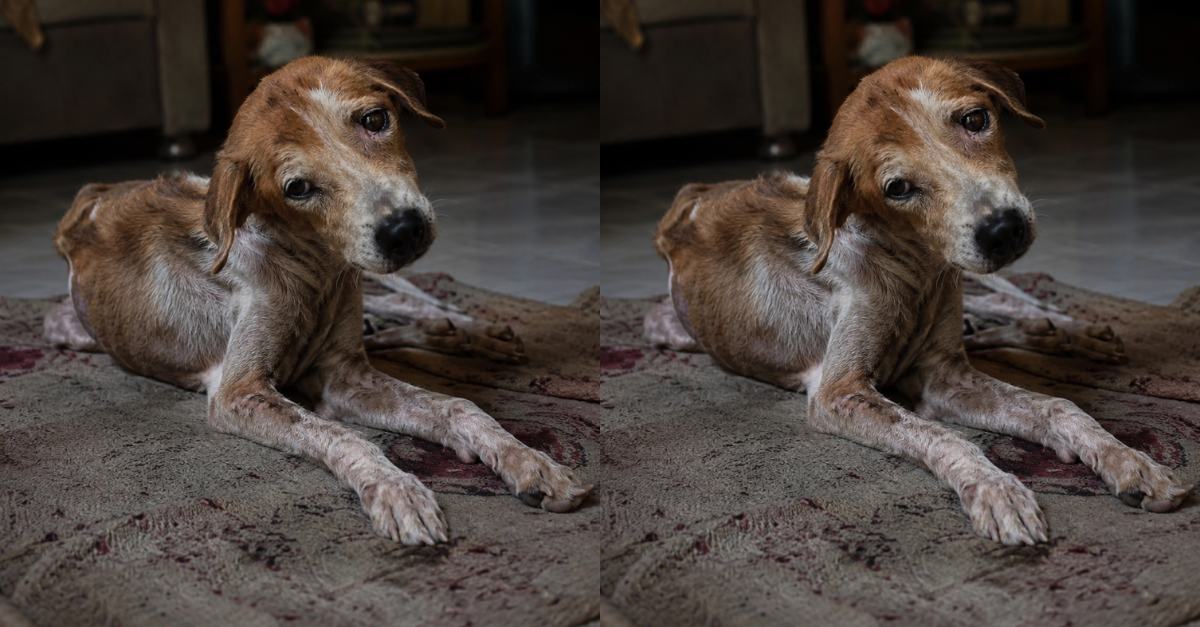
Lucky used to be the dog who ran to the door every time he heard it open.
He was a small brown-and-white dog with gentle eyes and a tail that once never stopped wagging. But after weeks of battling Canine distemper, Lucky was no longer the same. His body had grown painfully thin. His fur had become rough and dull. Most days, he could only lie curled up on an old mat in the corner of the living room, breathing weakly and struggling even to lift his head.
Whenever he heard footsteps nearby, Lucky still tried to look up.
He still tried to wag his tail.
But his legs trembled so badly that he could no longer stand.
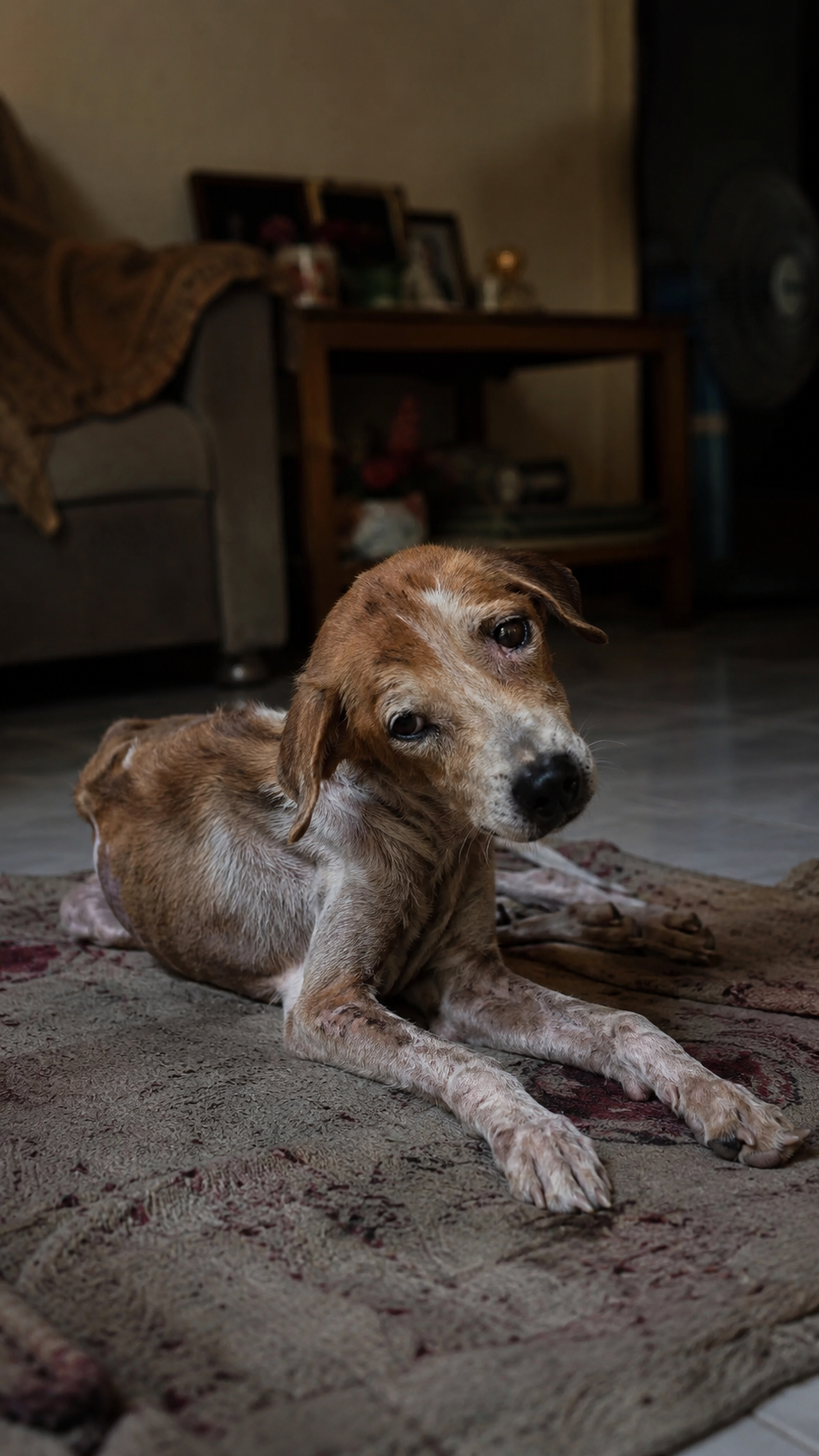
At first, his family had said they would help him.
They had taken him to the vet. They had listened to the doctor. They had said they would do what they could to save him.
But as the treatment bills grew thicker and the numbers became larger, something else began to change.
The love in their eyes slowly faded.
One evening, Lucky’s owner stood by the dining table, holding a growing stack of veterinary bills. He looked down at Lucky lying on the floor, but there was no tenderness left in his face. Instead of bending down to comfort him, he frowned at the papers in his hands and let out a frustrated sigh.
Lucky saw him looking.
His small tail gave the faintest wag.
But the man turned away.
It was as if the dog who had once been family had become nothing more than a problem with a price tag.
At the veterinary clinic, Lucky lay weakly on the examination table while the doctor explained that he still had a chance to survive. His condition was serious, but not hopeless. With time, treatment, and long-term care, Lucky could still live.
His owner held the treatment plan in silence.
His eyes moved down to the estimated cost.
His hand tightened around the paper.
And in that moment, Lucky stopped being a life worth fighting for.
He became an expense they no longer wanted to carry.
That night, Lucky was placed inside an old cardboard box on the back seat of the car.
He was too weak to sit up. He could only lift his tired eyes toward his owner. Streetlights passed over his face as the car moved through quiet roads in the dark.
Lucky still believed them.
Even after days of coldness and distance, he still thought they were taking him somewhere that might help him live.
But they were not taking him for treatment.
They were taking him away.
The car finally stopped along a quiet roadside on the edge of town.
The man lifted the cardboard box and set it down near a patch of bushes. Inside, Lucky lay trembling, his breathing shallow. He tried to lift his head and look after them as the car door shut, confusion filling his tired eyes.
There was no kind goodbye.
No final gentle touch.
No last attempt to comfort him.
Only a sick dog abandoned beside the road with an illness he had not yet recovered from.
Then the car drove away.
Lucky was left behind in the cold.
He tried to crawl out of the damp cardboard box, but his body was too weak. His legs trembled violently, and after only a few inches, he collapsed into the muddy ground.
Lucky did not understand what treatment costs were.
He did not understand money.
He did not understand why the people he loved most had turned their backs on him when he needed them the most.
All he knew was that he had been left alone.
The next morning, a woman named Anna was passing along the quiet road when she noticed the cardboard box move slightly.
She stopped.
Something about it felt wrong.
When she bent down and opened the flaps, her heart sank.
Inside was a small brown-and-white dog, weak and burning with fever, his eyes dull with pain but still soft. Even then, Lucky tried to wag his tail — just a little.
Anna had never met him before.
But one look into those eyes was enough.
She knew she could not leave him there another minute.
She wrapped Lucky in her coat and carried him to her car. His small body trembled with cold and illness as he lay in her arms. While driving, Anna kept glancing over at him, softly calling to him as if she were afraid that if she stopped, he might slip away forever.
For the first time in many days, Lucky was being held with tenderness.
Not because he was healthy.
Not because he was easy.
But because he was worth saving.
At the veterinary clinic, Lucky was placed on the treatment table and immediately given fluids and careful medical attention. The doctor checked his eyes, lungs, and neurological responses, all affected by Canine distemper. Anna stood beside him the entire time, her hand resting gently on his head, her eyes never leaving him.
The doctor warned her that recovery would be long.
Very long.
It would take patience, time, and money.
Anna asked only one thing:
“Is he still in pain… and what can I do to help him?”
Day after day, Lucky stayed in Anna’s care.
He lay on a soft bed in her home, surrounded by medicine, clean towels, and bowls of warm food. Anna wiped his face, helped him drink water little by little, and sat beside him through the worst moments.
She did not count how much she was spending on him.
She counted different things instead.
The first time Lucky ate a little more than yesterday.
The first time he slept peacefully through the night.
The first time his tiny tail moved again.
The first time his fearful eyes looked at her with something other than pain.
Slowly, the fear inside Lucky began to fade.
He was no longer looking at people as if waiting to be abandoned.
He was beginning to understand what safety felt like.
Weeks passed.
Then months.
Lucky grew stronger.
His brown-and-white fur became clean and soft again. His eyes no longer looked as frightened as they once had. He still carried the marks of everything he had gone through, but he was alive, warm, and surrounded by care.
In Anna’s home, Lucky was never treated like a burden.
He was never treated like a bill.
He was never made to feel that his life depended on whether or not he was convenient.
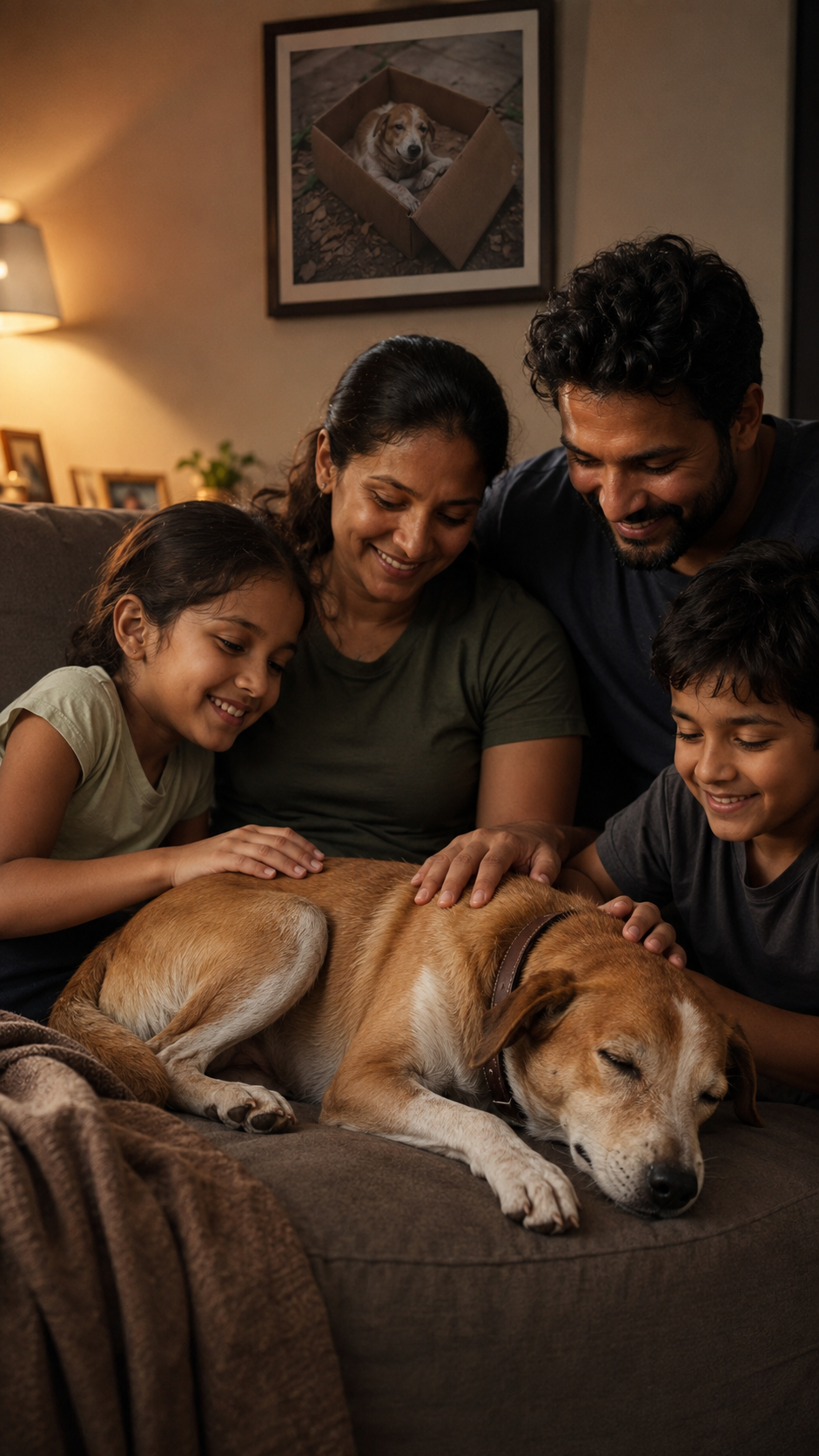
One afternoon, months after Anna had found him in that box, Lucky was lying peacefully on the sofa between Anna and the rest of her family. A new collar rested around his neck. On the wall behind him hung a photo from the first day Anna had found him abandoned by the roadside.
In the picture, he was weak, sick, and barely holding on.
Now, he slept in complete peace, surrounded by loving hands.
Lucky had once been thrown away because someone decided he was too expensive to save.
But in his new home, he was never measured by cost.
He was never reduced to numbers.
He was never seen as a problem.
He was family.
From a dog abandoned because treatment for Canine distemper was “too much,” Lucky became the most precious part of a new home.
He was no longer a burden.
He was a treasure.
